
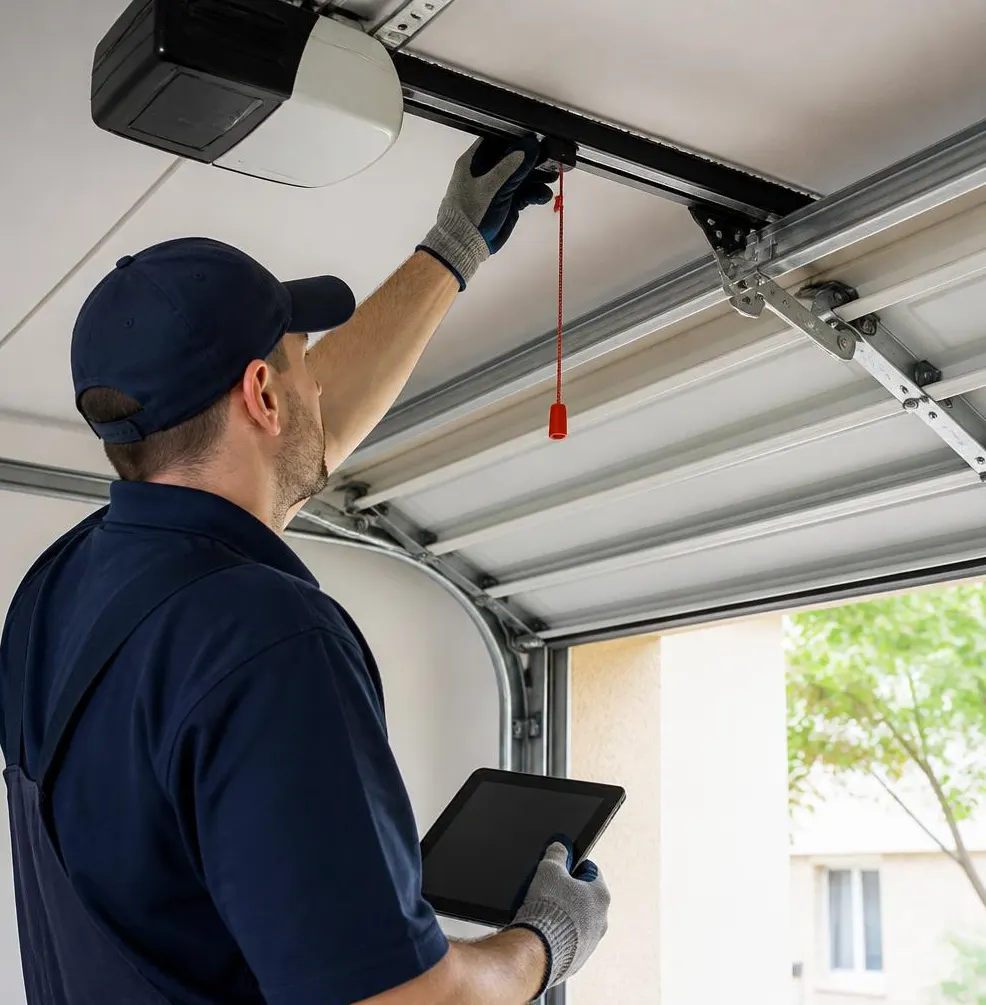
A Call We See Often Around Fishers
A technician pulls up to a home near Olio Rd in Fishers and finds a garage door stuck halfway up, with a dent in the bottom panel and a homeowner who's clearly frustrated. The story is almost always the same: the power went out, or the opener made a grinding noise and quit, so someone reached up and yanked the red emergency release cord to get the car out. The door came down hard, or it wouldn't budge at all once they tried to lift it by hand. Neither outcome is unusual, and neither one means the homeowner did anything unreasonable. The release cord is meant to be used — it's just misunderstood more often than any other part of the door.
What the Cord Actually Does
The emergency release disconnects the trolley from the opener's drive carriage. Once it's pulled, the motor is no longer connected to the door at all. That's it. It doesn't lock the door, it doesn't support the door's weight, and it doesn't do anything to the springs. All it does is let you raise and lower the door by hand instead of by motor.
This matters because the springs — not the cord, not the opener — are what actually hold the door's weight. The cord just decides whether the motor is in the loop or not.
When Pulling It Is the Right Call
- Power outage: This is the classic reason, and it's a good one. Pulling the cord lets you operate the door manually until power is restored.
- Opener malfunction: If the opener is grinding, humming without movement, or the gear has stripped, disconnecting it stops the motor from fighting the door and lets you move the door by hand in the meantime.
- Checking the door's balance: With the cord pulled, you can lift the door by hand to about waist height and let go. If it stays put, the springs are doing their job. If it drops or shoots up, that's useful diagnostic information before a repair call.
When Pulling It Makes Things Worse
The release cord becomes a problem the moment it's pulled on a door that isn't properly supported by its springs, or while the door is already up.
- A broken or weakened spring: If a spring has already snapped or is badly worn — common after a hard winter here, when cold temperatures make steel more brittle and salt and ice add extra friction to the tracks — the door has little or nothing holding its weight. Pull the cord in that condition and the door can drop fast, which is how dented panels, bent tracks, and smashed fingers happen.
- Pulling it while the door is open: If the door is up and you disconnect the opener, nothing is left to hold it in place except the springs. If those springs are compromised, the door will fall rather than stay put.
- Forcing it back into place incorrectly: Reconnecting the trolley to the carriage without lining it up properly can cause the opener to run the door into the track at an angle, which stresses rollers and hardware that are already working overtime through Fishers' seasonal swings between icy winters and humid summers.
The Safer Way to Use It
- Before pulling the cord, close the door fully if possible, so you're not relying on the springs to hold it open once the motor is out of the picture.
- Pull straight down on the cord, not at an angle, to avoid putting side load on the trolley mechanism.
- Test the door by hand in small movements rather than yanking it open all the way.
- When reconnecting, run the opener through a full open-close cycle once and listen for grinding or uneven movement before trusting it again.
When to Call Fishers Door & Opener
If pulling the cord revealed that your door won't stay balanced, drops suddenly, or feels unusually heavy, that's a spring problem, not a cord problem, and it's not something to keep working around by hand. Our Spring Replacement service addresses this directly with properly matched springs sized for your door's weight and local conditions. If the opener itself is the reason you had to disconnect it in the first place — stripped gears, a burned-out motor, or an opener that's simply worn out after years of Indiana winters — our Opener Repair & Installation team can get it running reliably or replace it with something built for the long haul.
If you're dealing with a stuck door, a bent track, or a spring that let go in Fishers, Noblesville, Carmel, or anywhere nearby, give Fishers Door & Opener a call. We'll get your door back in working order and make sure the next time you need that release cord, it works the way it's supposed to.